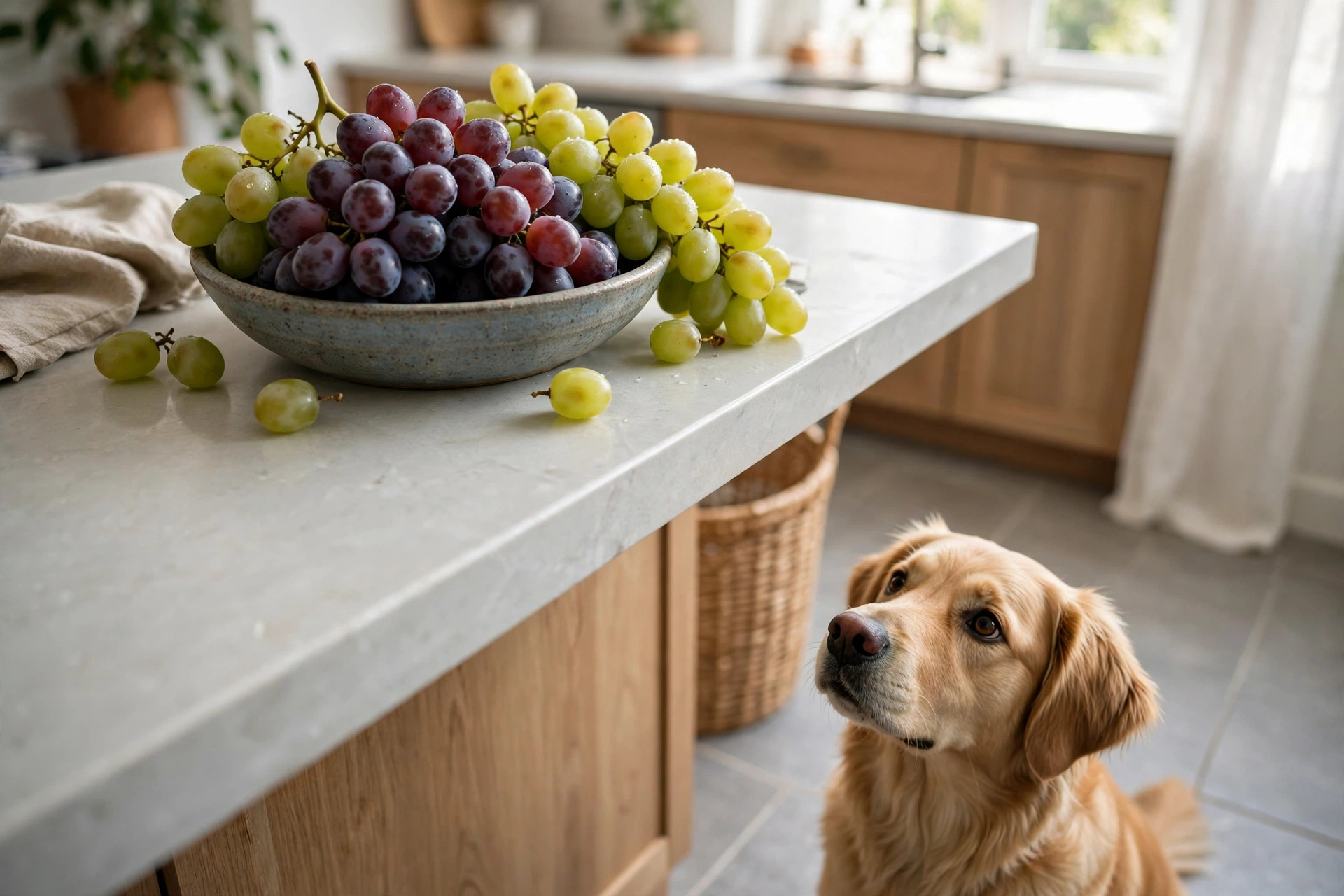
Can Dogs Eat Grapes? Why the Answer Is No
Grapes are one of the most confusing foods in a dog owner’s kitchen, because they are a healthy, everyday snack for people and a genuinely dangerous one for dogs. If you have ever dropped a grape on the floor and watched your dog snap it up before you could react, you will know the worry that follows. The question can dogs eat grapes has a clear answer, and it is one of the few food questions where there is no grey area: no, dogs should not eat grapes, and they should not eat raisins either. Even a small amount can make some dogs seriously ill, and because no one can predict which dogs will react badly, the only safe approach is to keep grapes away from dogs entirely. This guide explains why grapes are toxic, what the warning signs look like, what to do if your dog eats one, and which safe fruits you can offer instead — everything you need to know about can dogs eat grapes.
The Short Answer: Can Dogs Eat Grapes?
Can dogs eat grapes? No. Grapes and raisins are toxic to dogs, and they should never be given as a treat, not even one, and not even once to see what happens. The reason this answer is so firm is that sensitivity varies enormously from dog to dog. Some dogs have eaten grapes without any apparent problem, while others have become seriously ill after eating a very small amount, and there is no way to know in advance which group your dog falls into. Vets have linked kidney failure to very small amounts of grapes or raisins in some dogs, and because the consequences can be severe, every suspected ingestion is treated as an emergency. It does not matter whether the grapes are red, green, or black, seeded or seedless, fresh or dried: all grapes and all raisins carry the same risk. The same goes for grape juice, wine, and foods that contain grapes or raisins, such as trail mix, certain cereals, and some baked goods. If you remember one thing from this guide, let it be this: the answer to can dogs eat grapes is no, and it is always no.
Why Grapes Are Toxic to Dogs
One of the most unsettling things about grape toxicity is that, after years of research, vets still have not identified the exact compound in grapes that causes the problem. Several theories have been put forward, and recent research has pointed to a compound called tartaric acid as a likely culprit, but the full picture is still not settled. What is known is that eating grapes or raisins can cause stomach upset and, in some dogs, acute kidney injury, which is a sudden loss of kidney function. That is why vets answer can dogs eat grapes with a flat no for every dog, whatever its size or breed. The kidneys filter waste from the blood, and when they are damaged, waste builds up and the dog becomes progressively sicker over one to three days. This is not a matter of a dog being allergic to grapes in the usual sense; it is a toxic reaction that can affect dogs of any age, breed, or size. Smaller dogs are at greater risk from the same amount, because the dose is larger relative to their body weight, but large dogs have been affected too. The fact that the exact toxin is still unknown is itself a reason for caution, and it is part of why the can dogs eat grapes question has such a firm answer: there is no safe dose to calculate, no variety that is known to be harmless, and no home test to tell you whether your dog is one of the sensitive ones.
Can Dogs Eat Grapes in Small Amounts?
It is natural to ask whether a single grape is really dangerous, especially when you hear stories of dogs that ate grapes and seemed fine. The honest answer is that a single grape can be dangerous for some dogs, and there is no amount that vets consider safe. The stories of dogs that ate grapes without harm are real, but they are not evidence that grapes are safe: they only show that sensitivity varies, and that some dogs escape harm by luck. Vets have documented cases where kidney failure followed the eating of a very small number of grapes or raisins, and the risk is not worth taking for a treat your dog does not need. The same reasoning applies to raisins, which are dried grapes: because they are smaller and more concentrated, a dog can eat a large number of them quickly without you realising, and foods like trail mix and fruit cake can hide a surprising quantity. When people ask can dogs eat grapes in small amounts, they are usually hoping for a reassuring exception, but there is none to give. The safe amount is zero, and that is the rule to teach everyone in the household, including children, who are often the ones most likely to share their snacks with the family dog.
Signs of Grape Poisoning to Watch For
Grape poisoning does not always show itself immediately, which is one of the reasons the can dogs eat grapes question worries vets so much. The first signs often appear within six to twelve hours of eating grapes or raisins, and they usually start with stomach trouble: vomiting, diarrhoea, loss of appetite, and stomach pain. A dog may also become unusually tired, weak, or wobbly, and may drink a lot of water or, later, stop drinking. The more serious signs relate to the kidneys and tend to develop over the next one to three days: the dog may pass very little urine or stop urinating altogether, become dehydrated, and grow progressively sicker. Blood tests at this stage can show signs of kidney injury, which is why vets monitor bloodwork over several days even when a dog seems to be recovering. If you notice any of these signs after your dog may have eaten grapes, do not wait to see whether they get worse: contact your vet immediately and explain what happened. Early treatment is the whole point of knowing the can dogs eat grapes warning signs. Early treatment makes a real difference, and the hours after eating are when a vet can do the most good. It is also worth knowing that a dog can look perfectly normal for the first few hours, so a lack of symptoms early on is not a reason to relax.
What to Do If Your Dog Eats a Grape
If your dog eats a grape or a raisin, treat it as an emergency and contact your vet or an emergency vet clinic straight away, even if your dog looks fine. That is the one action every owner should remember from the can dogs eat grapes debate: call the vet first. Tell the vet what your dog ate, roughly how many, and when it happened, and follow their instructions. A vet may decide to make your dog vomit to bring the grapes back up, but this is only useful within the first few hours and should only be done by a vet or on a vet’s direct instruction. Do not try to make your dog vomit at home with hydrogen peroxide or any other remedy unless a vet specifically tells you to, because it can cause serious harm, including damage to the lungs if the dog breathes it in. Depending on the situation, the vet may give activated charcoal to reduce absorption, put your dog on intravenous fluids to protect the kidneys, and keep your dog in for monitoring with repeated blood tests over the next day or two. Even when the first blood tests look normal, vets often keep dogs under observation, because kidney damage can take a day or more to show up. Do not wait to see whether symptoms appear: the can dogs eat grapes emergency starts the moment the grape is swallowed, not when symptoms show. The most important thing is speed: the sooner your dog is seen, the better the chances of a good outcome. Save your vet’s number and your nearest emergency clinic’s number in your phone now, before you ever need them.
Raisins, Grape Juice, and Hidden Sources
Grapes are not the only form of the danger, and this is why the can dogs eat grapes rule covers raisins, currants, and sultanas too. Raisins are dried grapes, and they are just as toxic, with the added problem that they are small, easy to scatter, and often hidden in foods. Currants, sultanas, and dried grape products carry the same risk. Grape juice and wine are also unsafe, and foods that contain grapes or raisins are easy to overlook: trail mix, muesli and some cereals, fruit cake, hot cross buns, mince pies, some breads, and certain salads and stuffings. A dropped raisin on the kitchen floor or a handful of trail mix left on a low table is all it takes. To reduce the risk, keep grapes and raisins stored high up in sealed containers, never leave fruit bowls with grapes where your dog can reach them, and check the ingredient labels on snacks and baked goods before sharing them with your dog. Tell everyone in the house, including visitors and children, that grapes and raisins are never to be given to the dog, however much the dog begs. Prevention is far easier than treatment, and with grapes it is the only reliable protection there is.
Safe Fruit Alternatives to Grapes
The good news is that there are plenty of fruits your dog can enjoy instead of grapes, so the can dogs eat grapes question never needs a yes — and most dogs love the alternatives. Blueberries are an easy favourite: small, soft, and simple to offer a few at a time. Watermelon, with the seeds and rind removed, is hydrating and popular in warm weather. Banana slices, strawberries, raspberries, mango, and cantaloupe are all good options in moderation. Apples are another reliable choice, crisp and sweet, provided you remove the seeds and core first — our guide on can dogs eat apples explains exactly how to serve them. Pears, with seeds and core removed, and peaches, with the pit removed, are also fine. Vegetables such as carrots and green beans make good crunchy treats too. The same rules apply to all of these: introduce one new food at a time, start with a small amount, watch for any reaction, and keep treats to a small part of the daily diet. The American Kennel Club has a detailed guide to grape toxicity in dogs, including symptoms and treatment, at akc.org. With so many safe options available, there is no reason for grapes to be anywhere near your dog’s bowl.
How to Keep Grapes Away From Your Dog
Keeping grapes away from your dog takes a little planning, but the habits are simple, and they are the practical answer to the can dogs eat grapes problem: prevention, every day. Store grapes and raisins in sealed containers on high shelves or in closed cupboards, never in a fruit bowl on the table where a dog can reach them — a simple habit that makes the can dogs eat grapes question one you never have to face. If you eat grapes while watching television or working, keep the bowl well away from the dog and pick up any that fall immediately. Train your dog not to take food from counters and tables, and teach a reliable “leave it” command, which is useful for far more than grapes. When you have guests, especially children, tell them plainly that the dog must not be given grapes or raisins, and put the fruit bowl away before a party or gathering where food will be left out. Guests who know the can dogs eat grapes rule will not offer your dog a single grape, however much it begs. In the garden, if you grow grapes, fence the vines off so your dog cannot reach fallen fruit. And when you go for a walk, keep an eye on what your dog sniffs at on the ground, particularly near picnic areas where grapes and trail mix are often dropped. These habits take almost no effort once they are in place, and they remove a risk that is entirely avoidable.
Frequently Asked Questions
Can one grape kill a dog? Not every dog will have a severe reaction, but vets have linked kidney failure to very small amounts of grapes or raisins in some dogs. Because sensitivity varies and even one grape may cause illness, any ingestion should be treated as an emergency.
How long does it take for grape poisoning symptoms to appear? Many dogs develop vomiting, diarrhoea, or loss of appetite within six to twelve hours. Signs of kidney injury may not appear until one to three days after eating grapes.
Should I make my dog vomit if it eats grapes? Do not try to induce vomiting at home unless a vet specifically tells you to. Contact a vet immediately for guidance and treatment.
Are raisins more dangerous than grapes? Both are toxic. Raisins are dried and more concentrated, so a dog can eat a larger amount before anyone notices, but both should be treated as dangerous.
Are green grapes safer than red grapes? No. All grape varieties, red, green, or black, seeded or seedless, carry the same risk.
Can dogs eat grapes if they are seedless? No. Seedless grapes carry the same risk as seeded ones, and no variety of grape is safe for dogs.
Can dogs eat grape jelly? No. Grape jelly is made from grapes and should not be given to dogs.
What fruits are safe for dogs instead of grapes? Blueberries, watermelon, raspberries, mango, bananas, strawberries, cantaloupe, peaches without pits, pears without seeds or cores, and apples without seeds or cores, all in moderation.
The Bottom Line
Can dogs eat grapes? No — not one, not a few, and not as a rare treat. Grapes and raisins are toxic to dogs, the exact toxin is still unknown, sensitivity varies from dog to dog, and the consequences can include kidney failure. If your dog eats a grape or a raisin, contact your vet immediately, even if your dog looks fine, and do not try to treat it at home. Keep grapes and raisins out of reach, teach everyone in the house the rule, and offer one of the many safe fruits instead. This guide is general information, not veterinary advice: if you are ever unsure about something your dog has eaten, ask your vet first. With grapes, the safest choice is also the simplest one — keep them away from your dog, always.