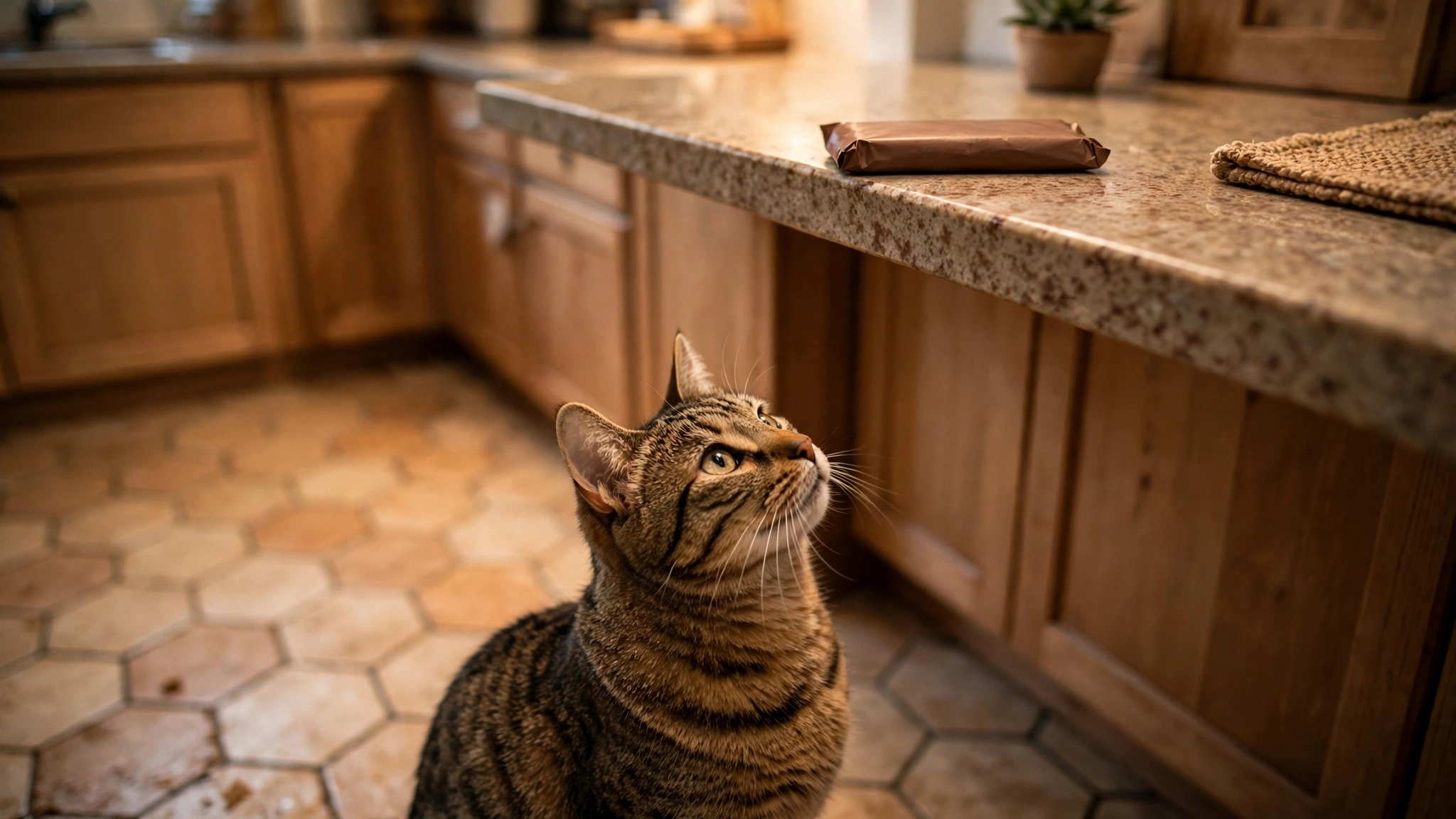
Can Cats Eat Chocolate? Why the Answer Is No
Can cats eat chocolate? The answer is no — and it is not a matter of preference or portion size. Chocolate is toxic to cats, and even a small amount can make a cat seriously ill. Cats are not small dogs, and they are certainly not small humans: their bodies process certain foods very differently, and chocolate contains two substances that cats cannot handle. If you share your home with a cat, this is one of the most important food-safety facts to know, and it is worth understanding properly rather than just remembering the rule.
Many cat owners are surprised by this, because cats usually show little interest in sweet food. Cats cannot taste sweetness the way humans do, so they rarely go looking for chocolate the way a dog might. But curiosity, an open wrapper, and a cat that investigates everything on the kitchen counter are enough. A cat does not need to eat a whole chocolate bar for it to be a problem, which is why prevention matters far more than treatment.
Why Chocolate Is Toxic to Cats
Chocolate contains two compounds that are dangerous to cats: theobromine and caffeine. Both belong to a group of substances called methylxanthines, and both stimulate the nervous system and the heart. Humans and some other animals break these compounds down relatively quickly, but cats metabolise them slowly, so they stay in the cat’s body longer and build up to dangerous levels. That is why the question can cats eat chocolate has such a firm answer: their bodies cannot clear theobromine quickly enough for any amount to be safe.
Theobromine is the main concern. It is present in all chocolate, but the amount varies a great deal by type. Dark chocolate and baking chocolate contain far more theobromine than milk chocolate, and cocoa powder contains more still. White chocolate contains very little theobromine, but it is still not a safe food for cats — it is high in fat and sugar, and it offers nothing a cat needs. The practical rule is simple: no type of chocolate is safe for a cat, and darker chocolate is more dangerous than lighter chocolate.
It is also worth knowing that the danger is not only about the chocolate itself. Many chocolate products contain other ingredients that are also unsafe for cats, such as xylitol, a sweetener that is toxic to pets, and macadamia nuts, which are also on the list of foods to keep away from cats. A chocolate dessert or a chocolate-flavoured snack can therefore be dangerous in more than one way.
Symptoms of Chocolate Poisoning in Cats
The signs of chocolate poisoning in a cat usually appear within a few hours of eating it, though they can take longer. Early symptoms often include vomiting, diarrhoea, and a loss of appetite. The cat may seem restless, agitated, or unusually thirsty, and may urinate more than usual. As the poisoning progresses, the symptoms can become more serious: a rapid heartbeat, trembling, muscle twitches, and in severe cases, seizures.
The severity depends on how much chocolate the cat ate, what type it was, and how big the cat is. A small cat that eats a piece of dark chocolate is in more danger than a large cat that licks a small amount of milk chocolate, but there is no amount that can be called safe. Even if the symptoms seem mild at first, they can worsen over hours, and the effects on the heart and nervous system can be serious. This is why any amount of chocolate ingestion should be treated as an emergency, not a wait-and-see situation.
What to Do If Your Cat Eats Chocolate
If you see your cat eat chocolate, or you find an empty wrapper and a guilty-looking cat, act immediately. Contact your veterinarian or an emergency animal poison helpline straight away, and tell them what type of chocolate it was, how much your cat ate, when it happened, and how much your cat weighs. Do not wait for symptoms to appear — by the time symptoms are obvious, the chocolate has already been absorbed. If you are unsure whether can cats eat chocolate applies to a lick or a bite, treat it the same way and contact your veterinarian.
Do not try to make your cat vomit at home unless a veterinarian specifically tells you to. Home remedies for inducing vomiting can be dangerous for cats, and they can cause more harm than the chocolate itself. Your veterinarian may induce vomiting safely in the clinic, give activated charcoal to reduce absorption, or provide supportive care such as intravenous fluids and monitoring, depending on how much was eaten and how much time has passed.
Keep the packaging if you can. The wrapper tells the veterinarian exactly what type of chocolate it was and how much was in the packet, which helps them judge how serious the situation is. If you are unsure how much your cat ate, say so honestly — it is better to overestimate the risk than to underestimate it.
Safe Treats Instead of Chocolate
Cats do not need sweet treats, and they do not miss chocolate. That is one reason can cats eat chocolate has such a firm answer — there is no benefit to a cat in eating it, only risk. If you want to give your cat a treat, choose something made for cats: commercial cat treats, a small piece of plain cooked chicken or fish, or a treat recommended by your veterinarian. Keep treats to a small part of the cat’s overall diet, and introduce any new food gradually.
Be careful with other human foods too. Onions, garlic, grapes, raisins, and lilies are all dangerous to cats, and lilies are extremely toxic even in tiny amounts. If you are unsure whether a food is safe for a cat, do not offer it — check with your veterinarian first. A good habit is to keep human food out of reach and to feed the cat from its own bowl, so the cat does not learn to beg from the table or investigate the kitchen counter.
How to Keep Chocolate Away From Your Cat
Prevention is straightforward once you build the habit. Store chocolate in closed cupboards or high shelves, not on the kitchen counter or the coffee table. Keep handbags and shopping bags closed, because cats are good at investigating bags left on the floor. Be especially careful at holidays, when chocolate is everywhere — Easter eggs, Christmas selections, advent calendars, and gift boxes are all risks, and a cat that is normally well-behaved can still be tempted by a box left open on the sofa. At those times, can cats eat chocolate is a question worth answering for everyone in the house: no, not even a taste.
Tell visitors and children the rule too. Well-meaning guests sometimes offer a cat a piece of chocolate, not knowing it is dangerous. A simple explanation — that the answer to can cats eat chocolate is no, because chocolate is toxic to cats — is usually enough. And if you have both cats and dogs, remember that the same rule applies to dogs: chocolate is toxic to them as well, and the same precautions apply.
Frequently Asked Questions About Can Cats Eat Chocolate
Can cats eat chocolate in small amounts? No. There is no safe amount of chocolate for a cat. Even a small amount can cause vomiting, diarrhoea, and restlessness, and larger amounts or darker chocolate can cause serious heart and nervous system effects. Keep all chocolate away from cats.
Can cats eat white chocolate? White chocolate contains very little theobromine, but it is still not safe for cats. It is high in fat and sugar, and it offers nothing a cat needs. The safest rule is to keep all chocolate, including white chocolate, away from your cat.
Can cats eat chocolate cake or biscuits? No. Can cats eat chocolate cake, brownies, or chocolate biscuits? The answer is the same as for a chocolate bar: no. Baked chocolate goods still contain theobromine, and they often contain other ingredients that are unsafe for cats as well.
Can cats eat chocolate ice cream? No. Chocolate ice cream contains chocolate, and the question can cats eat chocolate has the same answer whatever form the chocolate takes. It is also high in fat and sugar, which cats do not need.
What happens if a cat licks chocolate? Even a lick means the answer to can cats eat chocolate still applies: contact your veterinarian and tell them what happened, what type of chocolate it was, and how much your cat may have eaten. Do not wait for symptoms, and do not try to induce vomiting at home.
How long does chocolate poisoning take to show in cats? Symptoms often appear within a few hours, but they can take longer. Early signs include vomiting, diarrhoea, restlessness, and increased thirst. Severe symptoms, such as trembling or seizures, can develop later, which is why early veterinary advice matters.
Is chocolate more dangerous for kittens or small cats? Yes, in general. A smaller body means the same amount of chocolate has a greater effect, so kittens and small cats are at higher risk from the same quantity. But chocolate is dangerous for cats of any size, and any ingestion should be treated seriously.
Can cats eat chocolate? No — not a little, not a lick, and not the “safe” kind. Chocolate is toxic to cats because of theobromine and caffeine, and even a small amount can cause serious illness. The good news is that prevention is simple: keep chocolate stored away, keep bags closed, and tell everyone in the house the rule. If your cat does eat chocolate, contact your veterinarian immediately — fast action is the best thing you can do, and it can make all the difference.