How to Boil Chicken: Tender, Juicy Chicken Every Time
Boiled chicken does not have a glamorous reputation, but done properly it is tender, juicy, and incredibly useful. Learning how to boil chicken is one of the easiest ways to prepare chicken for the week ahead — it is the base for chicken salad, soups, sandwiches, tacos, and pasta dishes. The secret is gentle heat, enough water or broth to cover the chicken, and not overcooking it.
What Cut of Chicken Should You Use?
Boneless, skinless chicken breasts are the most common choice when you are learning how to boil chicken, because they cook evenly and are easy to shred or slice afterwards. Boneless thighs also work well and tend to stay juicier, because they have a little more fat. Bone-in pieces take longer and need extra care to check that they are cooked through, but they can give a richer flavour.
For your first time learning how to boil chicken, boneless, skinless breasts or thighs are the simplest option. Use pieces that are roughly the same size and thickness so they finish cooking at the same time.
What You Need
- A large pot with a lid
- Chicken breasts or thighs
- Water or low-salt chicken broth — enough to cover the chicken by a few centimetres
- Salt, and optional extras for flavour (see below)
- A food thermometer — the most reliable way to check chicken is cooked
- Tongs and a plate or chopping board
How to Boil Chicken: Step by Step
1. Place the chicken in the pot
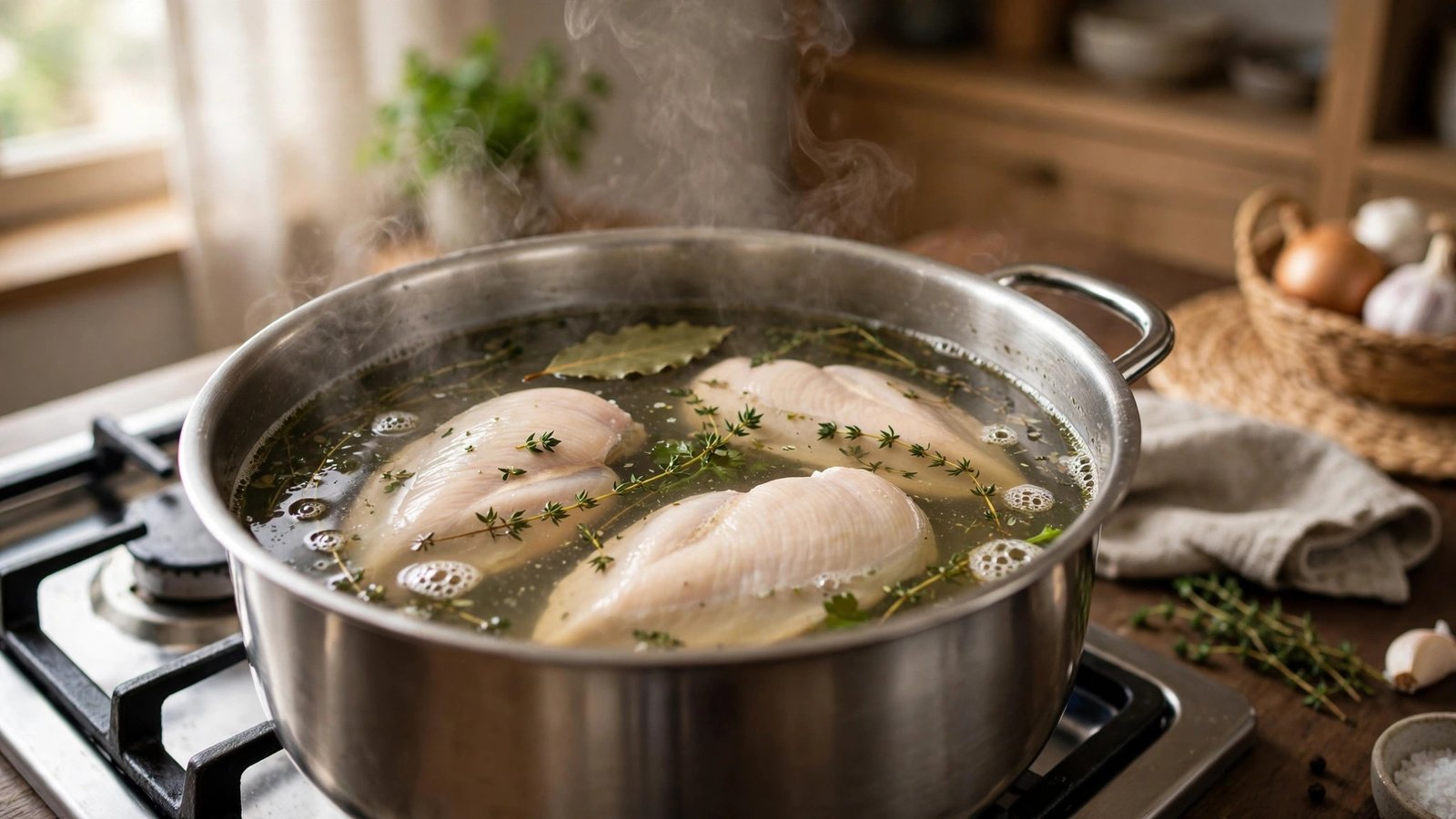
Put the chicken in a single layer in the pot. Do not stack the pieces on top of each other, or they will cook unevenly. Pour in cold water or broth until the chicken is covered by about 3–5 centimetres. Starting with cold water helps the chicken heat up gently and evenly.
2. Add flavour if you like
Plain boiled chicken is fine, but a few simple additions make a real difference:
- A teaspoon of salt per litre of water, or to taste
- A bay leaf
- A few whole peppercorns
- A halved onion or a few garlic cloves
- A stalk of celery or a carrot, roughly chopped
- A squeeze of lemon, or a few herbs such as thyme or parsley
You do not need all of these — even salt and a bay leaf are enough. Keep it simple the first time.
3. Bring to a gentle simmer
Place the pot over medium-high heat and bring the water just to a boil. As soon as it starts to boil, turn the heat down so the water is at a gentle simmer — small bubbles rising slowly, not a rolling boil. A hard boil is the main reason boiled chicken turns out tough and rubbery, so keeping the heat low matters more than anything else.
4. Cover and cook gently
Put the lid on the pot, leaving it slightly ajar so the water does not boil over, and let the chicken simmer gently. Cooking time depends on the size and thickness of the pieces:
- Boneless breasts, average size: around 15–20 minutes at a gentle simmer
- Boneless thighs: around 15–20 minutes
- Thicker breasts or bone-in pieces: around 25–30 minutes, or longer for large bone-in pieces
These are general ranges, not exact times. The only reliable way to know the chicken is done is to check its internal temperature.
5. Check that it is cooked through
Chicken is safe to eat when it reaches an internal temperature of 74°C (165°F) at the thickest part. Use a food thermometer and insert it into the centre of the thickest piece, away from any bone. If it has not reached that temperature, give it a few more minutes and check again. The FoodSafety.gov safe minimum internal temperatures chart lists 165°F (74°C) for all poultry.
Without a thermometer, cut into the thickest piece: the meat should be white all the way through with no pink, and the juices should run clear.
6. Rest, then slice or shred
Take the chicken out of the pot with tongs and place it on a plate or board. Let it rest for 5–10 minutes before cutting into it. Resting lets the juices settle back into the meat, so the chicken stays moist instead of drying out.
Once rested, you can slice it, cube it, or shred it with two forks — that is the easy part once you know how to boil chicken. Shredded chicken is ideal for tacos, sandwiches, and salads. If you are not using it straight away, let it cool and store it in a sealed container in the fridge.
Food Safety Basics
Chicken needs careful handling when you are learning how to boil chicken, because raw chicken can carry bacteria that cause food poisoning. A few simple habits keep things safe:
- Wash your hands after touching raw chicken, and before touching anything else.
- Do not wash raw chicken under the tap. Rinsing splashes bacteria around the sink and worktops. Cooking kills the bacteria; washing does not help.
- Use separate boards and knives for raw chicken and for ready-to-eat food such as salad or bread. Wash them well with hot, soapy water after use.
- Cook it through. Always check the internal temperature reaches 74°C (165°F), and do not serve chicken that is pink in the middle.
- Cool leftovers quickly. Do not leave cooked chicken sitting out at room temperature for more than about two hours. Refrigerate it promptly in a sealed container.
- Store and reheat properly. Cooked chicken keeps in the fridge for three to four days. Reheat it until it is piping hot all the way through, and only reheat it once.
FAQ
How long does it take to boil chicken?
Boneless breasts or thighs usually take around 15–20 minutes at a gentle simmer, depending on thickness. Bone-in pieces take longer, around 25–30 minutes. When you are learning how to boil chicken, always check the internal temperature reaches 74°C (165°F) rather than relying on time alone.
Should I boil chicken on high heat?
No — a key part of how to boil chicken is keeping the heat gentle. Bring the water to a boil, then turn the heat down to a gentle simmer. High heat and a rolling boil make chicken tough and dry.
Can I boil frozen chicken?
It is safer to thaw chicken in the fridge first, because frozen chicken cooks unevenly and the outside can overcook while the centre is still undercooked. If you must cook from frozen, allow roughly half as much time again, and always check the temperature at the thickest part — frozen chicken is harder to judge when you are learning how to boil chicken.
How do I know boiled chicken is done without a thermometer?
Cut into the thickest piece — the meat should be white all the way through with no pink, and the juices should run clear. A food thermometer is more reliable, so it is worth using one if you have it — especially when you are learning how to boil chicken.
Conclusion
Learning how to boil chicken well comes down to three things: gentle heat, enough liquid to cover the chicken, and checking that it reaches 74°C (165°F) inside. Keep the water at a simmer rather than a hard boil, let the chicken rest before you cut it, and handle raw chicken carefully. With those basics in place, you get tender, juicy chicken that works in dozens of meals — and a pot of light stock as a bonus. Boiled chicken also makes a handy protein for healthy snacks for work.