How to Organize Closet: A Step-by-Step System That Actually Sticks
Learning how to organize closet space is less about buying containers and more about deciding what belongs in the closet in the first place. Most messy closets are not short of storage; they are full of clothes that do not fit, do not suit the owner’s life any more, or were never worn in the first place. The system below works in any closet, from a small reach-in to a walk-in, and it is designed to stay tidy after the initial effort, with only a few minutes of upkeep each week.
Set aside a proper block of time for the first pass — a few hours for a small closet, most of a day for a large one. Trying to organise a closet in twenty-minute bursts usually means you stop halfway through, with clothes piled on the bed and no system at all. Put on some music, bring bags for donations, and commit to finishing.
Step 1: Take Everything Out
The first step in how to organize closet space is to empty it completely. Take every item out — clothes, shoes, bags, and the things that somehow ended up on the closet floor — and put them on the bed or on a clean sheet on the floor. This is the step most people want to skip, and it is the step that matters most. You cannot organise what you cannot see, and a closet that is emptied forces you to make a decision about every single item before it goes back in.
While the closet is empty, clean it properly. Vacuum or sweep the floor, wipe the shelves and rods, and check for anything that needs fixing: a sagging shelf, a loose rod, or a burnt-out light. A clean, well-lit closet is far easier to keep organised than a dark one, so replace the bulb if needed and consider a small battery-powered light if the closet has no fixture.
Step 2: Sort Into Four Piles
With everything out, sort each item into one of four piles: keep, donate, repair, and discard. Be honest with yourself. The keep pile is for clothes that fit, that you actually wear, and that suit your current life. The donate pile is for clothes in good condition that you no longer wear. The repair pile is for items you genuinely would wear again if they were fixed — a missing button, a loose hem — but set a deadline: if it is not repaired within a month, it goes in the donate pile. The discard pile is for worn-out, stained, or damaged items that nobody would want.
A useful test for each item is to ask three questions: does it fit right now, have I worn it in the past year, and would I buy it again today? If the answer to two or more is no, it probably belongs in the donate pile. Sentimental items are the exception — keep a small box for them elsewhere, rather than letting them take up prime closet space.
Step 3: Zone the Closet by Use
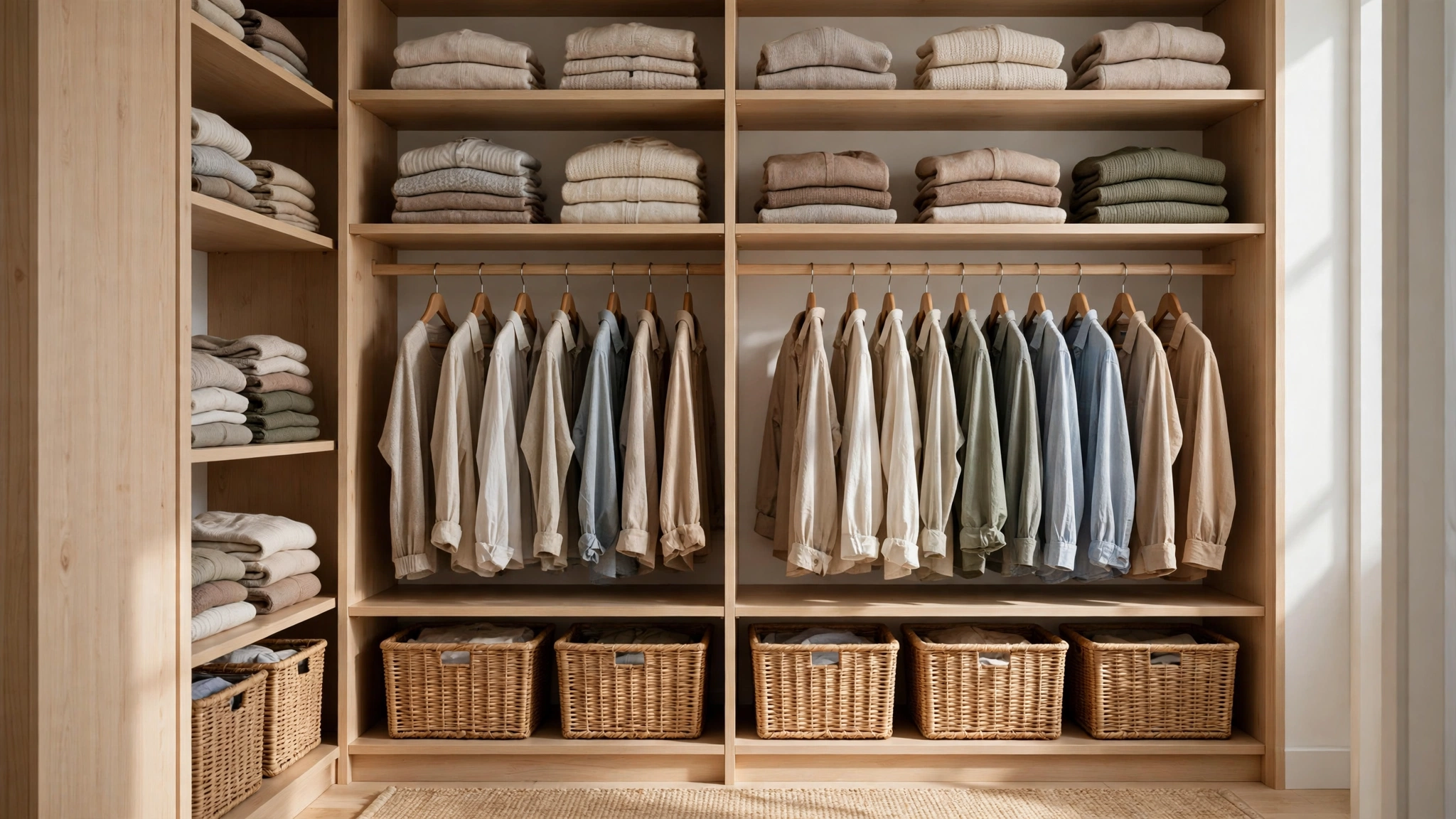
Once you know what is staying, plan the layout before anything goes back in. The best way to organise a closet is by zones: group items by how and when you use them. Everyday clothes go at eye level and within easy reach. Work clothes go together, casual clothes together, and special-occasion outfits go higher up or to one side. Shoes go on the floor or on a low rack, bags on a high shelf, and accessories in a drawer or a small organiser.
Hang the items you wear most often, and fold the rest. As a general rule, hang shirts, blouses, dresses, trousers, and jackets, and fold knitwear, T-shirts, and jeans — knitwear stretches out of shape on a hanger, and folded stacks are easier to see. Within each zone, arrange clothes by type and then by colour, from light to dark. It sounds fussy, but it makes finding an outfit much faster, and it makes the closet look calm instead of chaotic.
Step 4: Choose Storage That Fits the Space
Storage products help only after the decluttering is done, and that is a useful rule for how to organize closet storage without wasting money on containers for clothes you do not wear. Buying bins and organisers first is a common mistake: you end up with beautiful containers full of clothes you never wear. Once you know what is staying, measure the shelves and the hanging space, then choose storage to fit.
Matching hangers make a surprising difference. Thin, non-slip hangers take up less space than bulky plastic ones, keep clothes from sliding off, and make the closet look uniform. Shelf dividers stop folded stacks from toppling. Baskets and bins work well for accessories, scarves, and out-of-season items — label them so you can find things without opening every box. A small drawer unit or a hanging organiser can add storage to a closet with no built-in drawers. And a shoe rack, even a simple two-tier one, keeps shoes off the floor and visible.
Leave some empty space on purpose. A closet that is packed to the last inch is impossible to keep tidy, because every item you take out disturbs the ones around it. Aim to leave about a fifth of the hanging space and shelf space free. That breathing room is what makes the system sustainable.
Step 5: Fold and Hang So Things Stay Put
How you put clothes away matters as much as where you put them. Fold knitwear and T-shirts into neat, uniform rectangles and stack them with the folded edge facing out, so you can see what each stack is. For drawers, try file folding: fold items into small rectangles and stand them upright in rows, like files in a filing cabinet. It uses the space better and lets you see everything at a glance instead of digging through a pile.
When you hang clothes, button the top button of shirts and zip trousers before hanging them — it keeps their shape and stops them sliding off the hanger. Hang trousers over the bar of the hanger rather than clipped at the waist, which leaves marks. Keep a little space between hangers so clothes do not crush each other, and turn all the hangers the same way so the closet looks orderly.
Step 6: Handle Seasonal and Out-of-Season Clothes
If your climate has distinct seasons, rotating clothes twice a year keeps the closet from overflowing. A seasonal swap is part of how to organize closet space for the long term, not just a one-off tidy. At the change of season, move the clothes you will not wear for months into labelled bins on a high shelf or into under-bed storage. Wash or clean them before storing, and add a cedar block or lavender sachet to keep them fresh. When you swap them back, take the opportunity to repeat the quick version of the sort: anything you did not wear last season probably does not need to come back.
Shoes and accessories deserve the same treatment. Keep the current season’s shoes at the front of the rack and the others behind or above. Store bags stuffed with tissue paper so they hold their shape, and keep them on a shelf rather than hanging them by their handles, which stretches the straps.
Step 7: The Ten-Minute Weekly Reset
A closet stays organised because of maintenance, not because of the initial effort. Build a ten-minute weekly reset into your routine: put away the clean laundry properly instead of draping it over a chair, return anything that has drifted out of its zone, and re-fold any stacks that have toppled. Once a month, do a quick scan for items you have not worn and move them to the donate bag. Keeping a small donate bag in the closet makes this easy — when it is full, take it to a donation point.
The other habit that protects the system is the one-in, one-out rule. When a new item comes into the closet, an old one leaves. It sounds strict, but it is the simplest way to stop the closet from slowly filling up again. Most people find that once the closet is organised, they enjoy the rule, because every new purchase feels deliberate rather than accidental.
Frequently Asked Questions About How to Organize Closet
How to organize closet space when the closet is very small? In a small closet, the declutter is even more important, because there is no room to hide excess. Use slim hangers, add a second hanging rod for shorter items, use the door for hooks or a hanging organiser, and store out-of-season clothes elsewhere. Keep only the current season’s clothes in the closet itself.
How to organize closet shelves that are too deep? Deep shelves waste space at the back. Use bins or baskets that you can pull out like drawers, and put the least-used items at the back. Shelf dividers keep stacks upright and stop them from spreading across the whole shelf.
How to organize closet space on a budget? Start with the declutter, which costs nothing, and reuse what you already have: shoe boxes as drawer dividers, baskets you own, and matching hangers bought gradually. Knowing how to organize closet space on a budget is mostly about the sort, not the shopping — containers help only after the excess is gone.
How to organize closet clothes for a capsule wardrobe? Group the clothes you wear most into one zone, arranged by type and colour, and keep the rest stored separately. The capsule lives in the prime spot; everything else waits its turn. This is how to organize closet clothes so the everyday choice is fast and the seasonal swap is simple.
How often should I reorganise my closet? Do a full sort once or twice a year, usually at the change of seasons, and a ten-minute reset every week. A full reorganisation is only needed when the system stops working — usually because too many new items have come in without old ones leaving.
What is the best way to organize closet clothes by colour? Group by type first — all shirts together, all trousers together — and then arrange each group from light to dark. It makes choosing an outfit faster and gives the closet a calm, orderly look without any extra effort.
How to organize closet accessories like scarves, belts, and jewellery? Keep accessories visible and separated: hooks or a small rack for belts and scarves, a drawer organiser or a small tray for jewellery, and a shelf or a hanging organiser for bags. Accessories that are visible get worn; accessories buried in a box do not.
Knowing how to organize closet space is really about building a system that matches how you live: everything you wear regularly within easy reach, everything else stored properly, and a small weekly habit that keeps it that way. Empty the closet, be honest about what stays, zone by use, and leave yourself some breathing room. The result is not just a tidier closet — it is faster mornings, less stress about what to wear, and a wardrobe you actually use.