Best Fish Tank Filters: How to Choose the Right One for Your Aquarium
Choosing the best fish tank filters for your aquarium matters more than almost any other piece of equipment you buy. A good filter keeps the water clear, removes waste, and supports the invisible bacteria that keep your fish alive. A poor one leaves the water cloudy, lets waste build up, and forces you into constant emergency water changes. The good news is that picking the right filter is not complicated once you understand the four main types, how sizing works, and what your particular tank actually needs.
Before you compare models, it helps to know what a filter is actually doing. Every aquarium filter performs up to three jobs. Mechanical filtration traps visible particles such as uneaten food and plant debris in a sponge or pad. Biological filtration gives helpful bacteria a place to live; those bacteria convert fish waste from ammonia, which is toxic, into nitrite and then into nitrate, which is far less harmful and is removed by water changes and plants. Chemical filtration uses materials such as activated carbon to remove dissolved substances, odours, and discolouration from the water. The best fish tank filters handle the first two jobs well, and the third only when you need it.
Hang-On-Back Filters: The Best Fish Tank Filters for Most Beginners
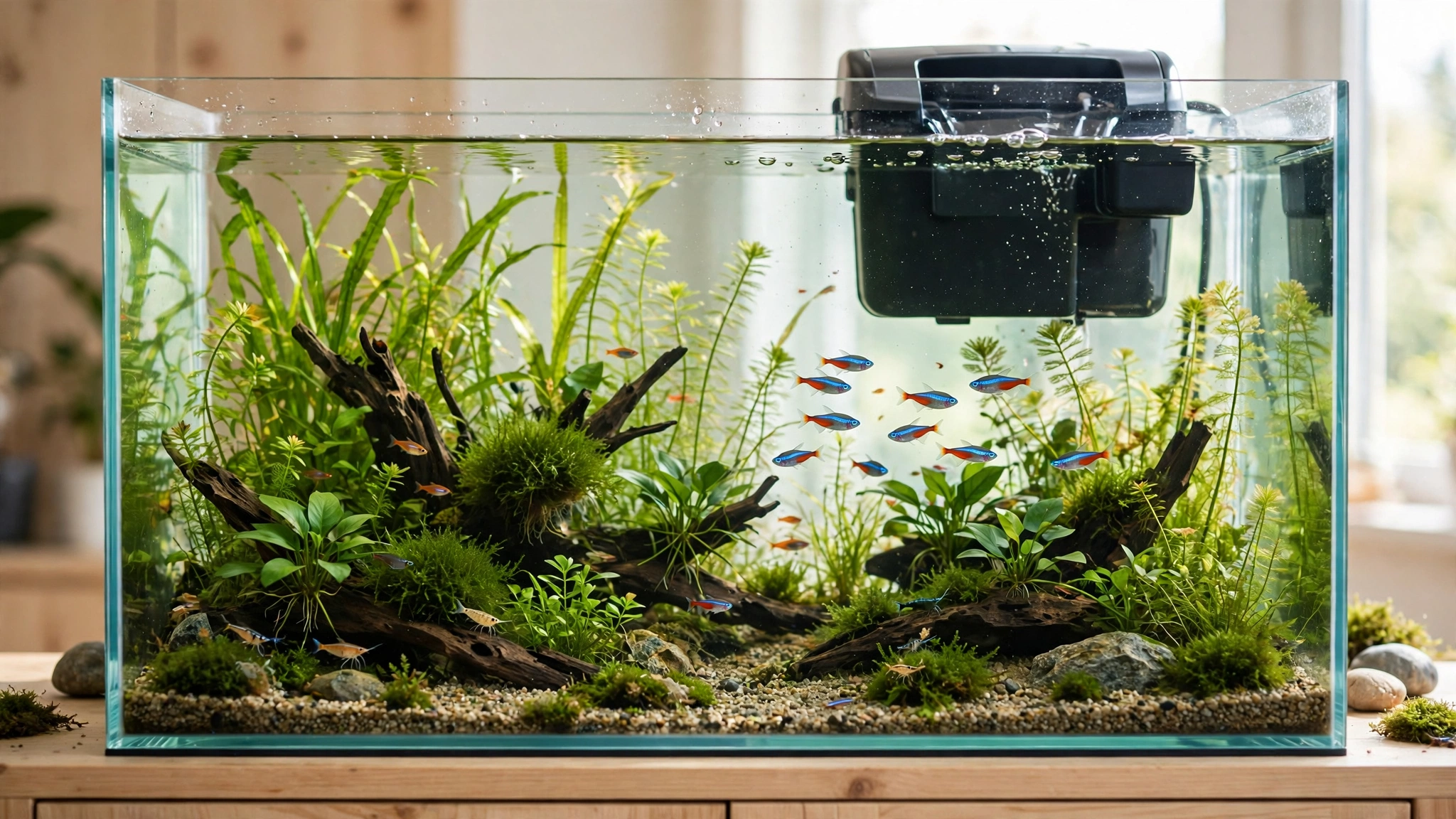
Hang-on-back filters, often called HOB filters, hang over the back rim of the tank and pull water up through a cartridge or basket of media, then pour it back in as a small waterfall. They are the most common choice for tanks up to around 50 gallons, and for good reason: they are simple to install, easy to maintain, and inexpensive to run. You lift the media out, rinse or replace it, and the filter is back in service in minutes.
Their main weakness is capacity. A hang-on-back filter holds a modest amount of media, so it suits lightly to moderately stocked community tanks better than heavily stocked tanks or very messy fish. They can also be slightly noisy, since water falls a short distance back into the tank, and the intake tube needs a guard if you keep very small fish or shrimp. Still, for a first aquarium, a hang-on-back filter is usually the right starting point.
Canister Filters: The Best Fish Tank Filters for Larger Tanks
Canister filters sit outside the tank, usually in the cabinet below, and push water through a large canister packed with layers of media. Because they hold far more media than a hang-on-back filter, they provide much stronger biological filtration, and they are the standard choice for tanks above 50 gallons, for heavily stocked tanks, and for aquariums with large or messy fish.
The trade-off is cost and effort. Canister filters cost more to buy, take longer to set up, and cleaning one means disconnecting hoses and carrying a canister to the sink. Many models include a priming button or valve system that makes this easier, and some have quick-disconnect taps. If you are setting up a large tank and want the water to stay clear with less frequent attention, a canister filter is worth the extra money and the learning curve.
Sponge Filters: Simple, Gentle, and Cheap
A sponge filter is exactly what it sounds like: a sponge, usually cylindrical, with an air tube running through it. An air pump pushes bubbles up the tube, and the rising water pulls tank water through the sponge. The sponge traps debris and, more importantly, gives helpful bacteria an enormous surface to colonise. Sponge filters are cheap, almost silent, and extremely gentle, which makes them a favourite for breeding tanks, fry tanks, and shrimp tanks, where a strong intake could harm tiny animals.
They are not the best choice as the only filter on a large or heavily stocked display tank, because they provide little mechanical polishing and take up space inside the aquarium. But as a second filter, a backup, or the main filter on a small tank, a sponge filter is hard to beat for value. Many experienced keepers run one alongside a hang-on-back or canister filter for extra biological capacity.
Internal Filters: Compact Power Inside the Tank
Internal filters sit fully underwater, usually suction-cupped to the back glass. They are compact, quiet, and easy to hide behind plants or decorations, which makes them popular for small tanks, betta tanks, and aquariums where an external filter would look out of place. Most have an adjustable flow, so you can turn the current down for fish that prefer calm water.
The drawback is that they take up room inside the tank and hold less media than an external filter of the same price. They also need regular cleaning, since their small media compartment clogs faster. For a nano tank or a desktop aquarium, an internal filter is often the tidiest solution. For anything larger, an external filter usually serves you better.
How to Size the Best Fish Tank Filters for Your Tank
Sizing is where most beginners go wrong, and it is simpler than it looks. Start with the manufacturer’s rating and choose a filter rated for your tank’s volume or slightly above it — a filter rated for a 20-gallon tank on a 20-gallon tank is the minimum, and going one size up is a sensible habit, especially if your tank is heavily stocked. Manufacturer ratings assume a lightly stocked tank, so a filter rated for your exact volume is already working at its limit on a busy tank.
A common rule of thumb is to aim for the filter to turn over the tank’s water several times per hour, but the exact number matters less than the combination of flow and media volume. Choosing among the best fish tank filters means matching flow and media volume to your stocking level, not just buying the biggest box on the shelf.
What you really want is enough media for a strong bacterial colony and enough flow to pull waste toward the intake without turning the tank into a washing machine. Fish that come from slow-moving water, such as bettas, do better with gentle flow, while fish from rivers appreciate a stronger current. If the flow seems too strong, you can baffle the output with a sponge or aim it at the glass to break it up.
Filter Media: What Goes Inside and Why
The media inside a filter matters as much as the filter itself. Mechanical media, usually a coarse sponge or a fine pad, catches particles. Biological media — ceramic rings, porous rock, or bio-balls — provides surface area for bacteria and should almost never be replaced all at once, because doing so removes the bacteria your tank depends on. Chemical media, such as activated carbon, is optional: it helps remove odours and discolouration, but it is used up after a few weeks and is not needed in every tank.
A practical setup is a coarse sponge first, then biological media, then a fine pad or carbon last. When you clean the filter, rinse the media in water taken from the tank during a water change, never under the tap, because tap water can kill the helpful bacteria. Replace mechanical pads when they fall apart, but keep biological media until it physically crumbles.
Noise, Maintenance, and Running Costs
A filter runs all day, every day, so noise matters. Hang-on-back filters make a gentle waterfall sound that some people like and others find distracting in a bedroom. Canister filters are usually the quietest, since the motor is sealed and underwater flow is gentle. Sponge filters are nearly silent apart from the air pump, which can hum; placing the pump on a soft surface or using a quieter model helps.
Maintenance is straightforward if you keep to a routine. Check the intake for debris weekly, rinse mechanical media every couple of weeks, and replace carbon only if you use it. Most filters last for years with basic care; the parts that wear out are usually impellers and seals, and spare parts are widely available for popular models. When you compare the best fish tank filters, look at the cost of replacement media as well as the price of the filter itself, because cheap cartridges add up over time.
Common Mistakes to Avoid
The most common mistake is turning the filter off at night to reduce noise. A filter must run constantly; switching it off starves the bacteria of oxygen and lets waste build up within hours. Another mistake is replacing all the media at once, which can crash the bacterial colony and cause an ammonia spike. A third is choosing a filter purely by price and ending up with one that is too small for the tank. Finally, remember that a filter does not replace water changes. Even the best fish tank filters leave nitrate behind, and regular partial water changes are still the main way to keep nitrate low.
How to Decide: A Simple Checklist
Work through these questions and the right choice usually becomes obvious. How big is the tank, and how heavily is it stocked? A small, lightly stocked tank does well with a hang-on-back or internal filter, while a large or busy tank needs a canister. What kind of fish do you keep? Delicate or slow-moving fish need gentle flow; messy fish need capacity. Where is the tank? A bedroom tank rewards a quiet canister or sponge filter. What is your budget, including replacement media? Answer those four questions honestly and you will narrow the field to one or two sensible options.
Frequently Asked Questions About the Best Fish Tank Filters
What are the best fish tank filters for a beginner? For most beginners, the best fish tank filters are hang-on-back filters on tanks up to around 50 gallons. They are affordable, easy to install, and simple to maintain, and they handle a typical community tank well. A sponge filter is a good second choice for a small or breeding tank.
How do I know what size filter my tank needs? Choose a filter rated for your tank’s volume or one size larger. Manufacturer ratings assume light stocking, so if your tank is heavily stocked, go bigger. Make sure the flow is adjustable or can be baffled if your fish prefer calm water.
What are the best fish tank filters for a planted tank? For a planted tank, the best fish tank filters are usually a canister filter or a hang-on-back filter with adjustable flow. Plants prefer gentle water movement, so choose a filter you can turn down, and avoid strong surface agitation, which drives off the carbon dioxide plants use.
How often should I clean my fish tank filter? Rinse mechanical media every couple of weeks in tank water from a water change, and check the intake weekly for debris. Biological media should be rinsed gently and rarely replaced. Never clean filter media under the tap, and never replace all the media at once.
Do I need a filter if I have live plants? Yes. Plants absorb some nitrate and produce oxygen, but they do not remove solid waste or provide the water movement and bacterial surface a filter offers. Even a heavily planted tank needs filtration, though it can often get by with a smaller filter.
Can a fish tank filter be too strong? Yes. Too much flow stresses fish that prefer calm water, pushes small fish around, and can prevent them from feeding comfortably. If the current is too strong, turn the flow down, baffle the output, or choose a filter with adjustable flow.
The best fish tank filters are not the most expensive ones; they are the ones matched to your tank, your fish, and your routine. Start with the tank size and stocking level, pick the type that fits, size it generously, and keep up with simple maintenance. Do that, and the filter will quietly do its job for years while your fish stay healthy and your water stays clear.