Best Ukulele for Beginners: How to Pick Your First Uke
The ukulele is one of the friendliest instruments a beginner can pick up. It has only four strings, its chords are simple to learn, and you can play a recognisable song within your first week. But the best ukulele for beginners is not simply the cheapest one on the shelf, and it is not the most expensive one either. It is the one that fits your hands, stays in tune, and sounds good enough that you actually want to pick it up every day. This guide explains the sizes, the materials, and the checks that matter, so you can buy once and buy well.
Start with the most important fact: a ukulele that will not stay in tune will kill your motivation faster than anything else. Many very cheap instruments have poor tuners, rough frets, or strings that stretch unevenly, and a beginner cannot tell whether the problem is the instrument or their own playing. Spending a little more on a decent starter instrument is the single best investment you can make as a new player, and it is what separates the best ukulele for beginners from a toy that ends up in a cupboard.
Best Ukulele for Beginners: The Four Sizes Explained
Ukuleles come in four main sizes, and the size affects both the sound and how the instrument feels in your hands.
The soprano is the smallest and the classic ukulele sound most people recognise: bright, cheerful, and plucky. It is also the most affordable size and the easiest to carry. Its short scale makes the frets close together, which suits smaller hands but can feel cramped if you have large fingers.
The concert is slightly larger, with a fuller sound and a little more room between the frets. Many teachers recommend the concert as the best ukulele for beginners because it balances the traditional bright sound with extra comfort. If you are unsure which size to choose, start here.
The tenor is larger still, with a deeper, warmer tone and even more fret space. It suits players with bigger hands, people who want to play fingerstyle, and anyone who finds the soprano too small. Tenors are also common among performers.
The baritone is the largest, tuned differently from the other three, and it sounds closer to a small guitar. It is a lovely instrument, but it is not the usual first choice for a beginner, because most beginner lessons, songs, and chord charts are written for the soprano, concert, and tenor tuning.
If you can, hold each size before you buy. Sit with it, reach around the neck, and see which one feels natural. The right size is the one your hands are comfortable on, not the one a chart says you should play.
Solid Wood vs Laminate: What Actually Matters
Ukulele bodies are made from solid wood or laminate, and the difference affects both sound and price. A solid wood top vibrates more freely, which usually gives a warmer, richer tone that improves as the wood ages. A laminate top is made from thin layers of wood pressed together; it is tougher, less sensitive to humidity changes, and much cheaper.
For a first instrument, laminate is a perfectly sensible choice. It is durable, it sounds perfectly good for learning, and you will not worry about it if the room gets dry in winter. Solid wood is worth considering if you have a slightly larger budget and you know you will keep playing. Some starter instruments use a solid top with laminate back and sides, which is a good middle ground: you get much of the tonal benefit at a lower price.
The wood species matters less than the build quality. Mahogany gives a warm, mellow sound, koa gives a bright and sweet tone, and spruce is clear and punchy. As a beginner, do not overthink the species; a well-made laminate ukulele will serve you better than a poorly made solid wood one.
What to Check Before You Buy
Whether you buy in a shop or online, run through these checks. First, look at the frets: they should be smooth, with no sharp ends sticking out past the edge of the fretboard. Rough fret ends are uncomfortable and are a sign of poor workmanship. Second, check the action, which is the distance between the strings and the fretboard. If the strings sit very high, pressing them down will hurt your fingers and notes will sound out of tune. If they sit too low, they will buzz against the frets. A comfortable action is one of the biggest differences between a good starter instrument and a frustrating one.
Third, check the tuners. They should turn smoothly and hold their position without slipping. Friction tuners, which are common on very cheap sopranos, can be harder to use precisely; geared tuners are easier for a beginner. Fourth, play every fret on every string if you can, and listen for buzzing or dead notes. Finally, check that the strings are in good condition and that the instrument comes with a gig bag or case, which protects it when you carry it around.
If you buy online, buy from a seller that sets up the instrument before shipping. A basic setup — adjusting the action and checking the frets — makes a large difference, and a seller that offers it is usually selling instruments that are worth owning.
Accessories Worth Having From Day One
You do not need much to start, but a few accessories make learning easier. A clip-on tuner is the most useful: it clips to the headstock, shows whether each string is in tune, and works even in a noisy room. Many beginners also use a free tuner app on their phone, which works well too.
A comfortable strap helps if you play standing up, though many players hold the ukulele against their body without one. A spare set of strings is cheap and worth keeping, because a broken string in the middle of practice is annoying. A simple gig bag protects the instrument when you take it to a lesson or a friend’s house. Beyond that, wait until you know what you need; a pile of accessories will not make you a better player, but regular practice will.
Your First Week: A Simple Practice Plan
The best ukulele for beginners is the one you actually play, so make the first week easy. Start by learning to tune the instrument — standard tuning, from the string nearest your chin to the one nearest the floor, is G, C, E, A. A clip-on tuner or an app will guide you. Then learn three chords: C, Am, and F. With just those three, you can play dozens of simple songs.
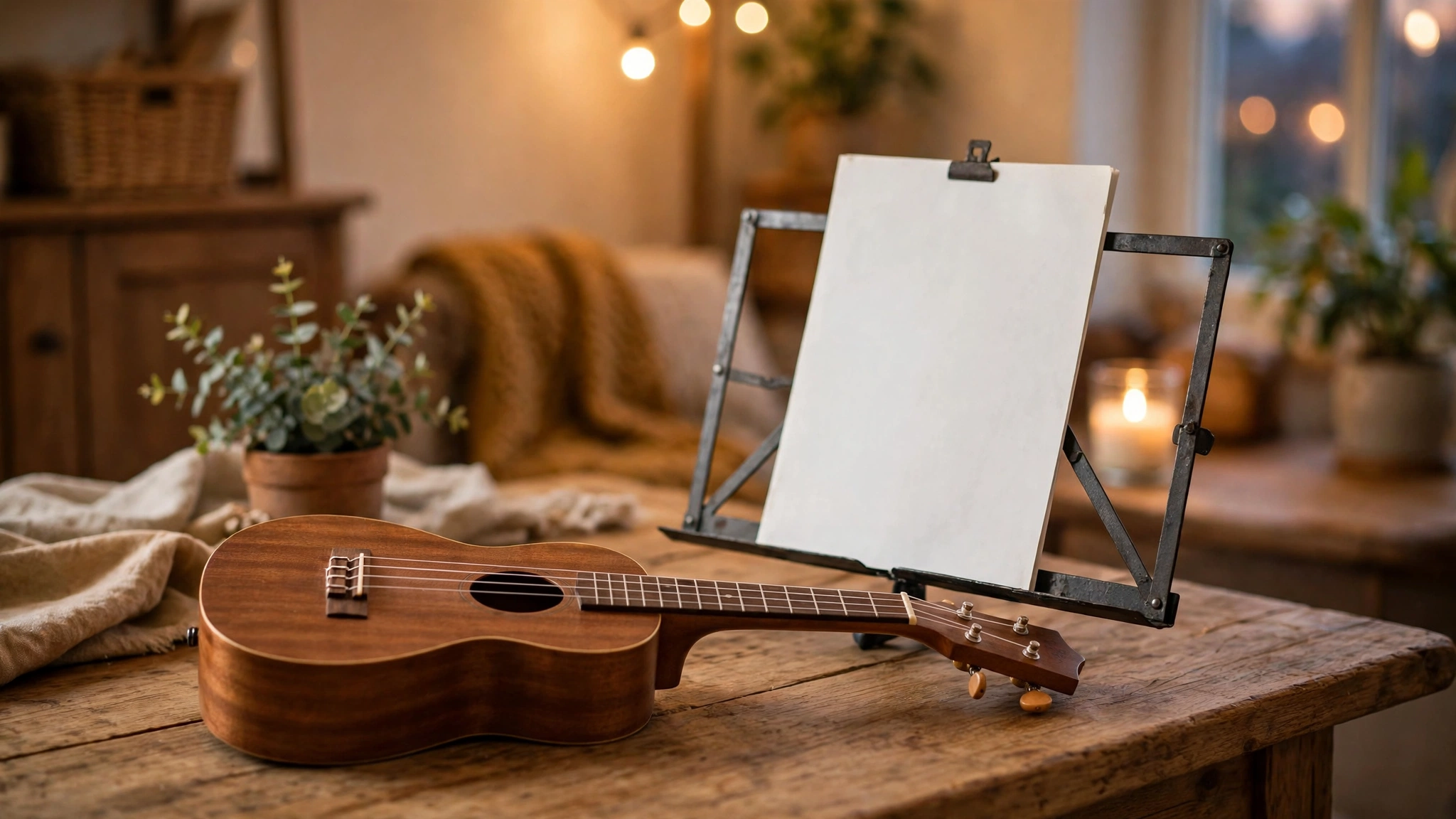
Practice in short sessions of ten to fifteen minutes rather than one long session. The best ukulele for beginners is the one that gets played a little every day, not the one that sits in a cupboard waiting for a long weekend session. Short, regular practice builds muscle memory faster and keeps your fingertips from getting too sore. Keep the ukulele somewhere visible, on a stand or on a hook, rather than in a cupboard; instruments that are easy to reach get played far more often.
After the first three chords, add G and then Dm, and you will have the chords for a huge number of popular songs. Learn one strumming pattern at a time, and play along with simple recordings. The goal of the first month is not speed or perfection; it is getting comfortable holding the instrument, changing chords smoothly, and keeping a steady rhythm.
Common Beginner Mistakes to Avoid
The most common mistake is squeezing the neck too hard. A death grip tires your hand, slows your chord changes, and makes notes buzz. Press just hard enough for the note to ring clearly, and relax your thumb on the back of the neck.
Another mistake is ignoring tuning. A ukulele goes out of tune easily, especially when its strings are new, and playing an out-of-tune instrument trains your ear badly. Check the tuning every time you pick it up; it takes less than a minute.
A third mistake is trying to learn too many songs at once. Pick one song, learn it properly, and move on. Finishing songs builds confidence, and confidence keeps you playing. Finally, do not compare your first month to someone else’s third year. Everyone sounds rough at the start, and the players you admire sounded rough too.
Frequently Asked Questions About the Best Ukulele for Beginners
What is the best ukulele for beginners who have never played an instrument? A concert-size ukulele with geared tuners and a comfortable action is a good default choice for most new players. It balances a full sound with comfortable fret spacing, and most beginner lessons and chord charts work well with it.
How much should I spend on my first ukulele? Avoid the very cheapest instruments, because poor tuning stability and rough frets make learning harder than it needs to be. A modest starter instrument from a reputable seller, ideally one that sets the instrument up before shipping, is a better investment than the lowest-priced option.
Is the soprano or concert ukulele better for beginners? Both work well. The soprano is smaller, cheaper, and has the classic bright sound, while the concert is slightly larger with a fuller tone and more room between the frets. If you have larger hands, the concert usually feels more comfortable. Try both if you can.
Is a concert ukulele the best ukulele for beginners? For most new players, yes. A concert ukulele balances a fuller sound with comfortable fret spacing, and it suits a wide range of hand sizes. If you have very small hands, a soprano may feel better; if you have large hands, try a tenor. The best ukulele for beginners is the size that feels comfortable in your hands.
What should the best ukulele for beginners come with? At minimum, a gig bag or case and a clip-on tuner are worth having from day one. A spare set of strings is cheap insurance. The best ukulele for beginners is not defined by accessories, but these three make learning easier and protect the instrument.
How long does it take to learn the ukulele? Most beginners can play a simple song within a week or two of short daily practice, and can change between basic chords smoothly within a month or two. Progress depends far more on regular practice than on talent.
Do I need lessons to learn the ukulele? Not necessarily. Many beginners learn from free online lessons, chord charts, and play-along videos. A few lessons with a teacher can help you avoid bad habits early on, but self-teaching works well for this instrument.
The best ukulele for beginners is the one that fits your hands, stays in tune, and makes you want to play it again tomorrow. Choose the size that feels comfortable, check the frets and tuners before you buy, keep it somewhere you can reach it, and practise a little every day. Do that, and the instrument will do the rest.