Best Dry Cat Food: What to Look For Before You Buy
Walk into a pet store and the dry cat food aisle can feel endless. Row after row of bags, each one promising the healthiest, most natural, most complete meal your cat will ever eat. It is easy to assume the most expensive bag is the best, or the one with the prettiest picture, or the one your friend’s cat loves. But cats are individuals, and the bag that suits one cat may not suit another. The best dry cat food is not a single product on a shelf — it is the one that fits your cat’s age, health, and tastes, and the way to find it is to learn what the label is telling you.
This guide explains how to read a cat food label, why life stage matters, what to look for in the ingredients, and when to ask your vet. It does not rank brands or name a winner, because no article can test every product or know your cat. What it can do is give you the tools to judge any bag for yourself, so the choice you make is an informed one. That is what finding the best dry cat food really comes down to: knowing what to check, not trusting the loudest bag.
What “Best” Really Means for Your Cat
“Best” is a slippery word when it comes to cat food. A food that is best for a growing kitten is not best for a senior cat with kidney concerns. A food that suits a healthy, active cat may not suit a cat that needs to lose weight. And a food with an excellent label is not the best food if your cat refuses to eat it. The first step is to stop looking for a universal winner and start looking for the right fit.
Your cat’s age is the biggest factor. Kittens, adults, and senior cats have different needs, and food makers design different formulas for each stage. Your cat’s health is the next factor — a cat with a known condition may need a particular kind of food, and that is a decision to make with your vet, not with a bag’s marketing. Your cat’s preferences matter too: some cats like small kibble, some like larger pieces, and some are simply fussy. A food your cat will not eat cannot be the best food for them, whatever the label says.
The best dry cat food for your cat is the one that matches their life stage, suits their health, and that they actually eat with enthusiasm — and that you can afford to keep buying. Price matters, because a food you can only afford for a month is not a sustainable choice. A mid-priced food that your cat eats happily every day is a better choice than a premium food that strains the budget or sits untouched in the bowl.
Reading the Label: The Basics
The label on a bag of cat food carries more useful information than the pictures and promises on the front. Learning to read it takes a few minutes, and it changes how you shop. Start with the guaranteed analysis, which lists the minimum levels of protein and fat and the maximum levels of fibre and moisture. These numbers describe the food as a whole, but they do not tell you where the nutrients come from, so they are a starting point rather than a verdict.
Next, look at the ingredient list. Ingredients are listed in order of weight before cooking, so the first few ingredients make up the largest share of the food. A list that starts with a named animal protein, such as chicken or fish, tells you more than a list that starts with a vague term. Named ingredients are specific; generic terms like “meat” or “animal by-products” tell you less about what is actually in the bag.
Also look for a nutritional adequacy statement. This is the small print that says the food is complete and balanced for a particular life stage, and which organisation’s standards it meets. A food that carries a statement for “all life stages” is designed to meet the needs of both kittens and adults, while a food with a statement for “adult maintenance” is designed for adult cats only. This statement is one of the most reliable things on the label, because it means the food has been checked against a published standard. If a bag lacks that statement, choosing the best dry cat food becomes guesswork — move on to a bag that carries one.
Life Stage Matters
Kittens grow fast, and their food is designed for that. Kitten food is usually more energy-dense than adult food, because a growing kitten needs more energy and nutrients per mouthful than an adult cat. It is also designed to support growth and development, and it is usually fed until the cat reaches adulthood, which is generally around the first year. Feeding a kitten adult food, or an adult cat kitten food, is a mismatch that is easy to avoid by checking the life stage on the label.
Adult cats need a food that maintains their weight and condition without adding excess energy. Most adult cats do well on a food made for adult maintenance, fed in the amount the guide suggests and adjusted for activity. For most healthy adults, the best dry cat food is simply the adult formula they eat willingly and that keeps their weight steady. Indoor cats, which tend to be less active than outdoor cats, may do better on a food designed for lower activity, but the amount you feed matters at least as much as the formula you choose.
Senior cats are a more individual group. Some older cats stay active and healthy and do well on an adult food, while others develop health concerns that change what they need. There is no single age at which a cat becomes a senior, and no single senior formula that fits every older cat. If your cat is getting older, a check-up with your vet is the best way to decide whether a change of food is needed — and if so, which kind.
Cats with health conditions need special care. A cat with kidney concerns, a sensitive stomach, a food allergy, or a weight problem may need a food designed for that condition, and some of those foods are only available through a vet. If your cat has a health concern, the vet’s advice matters far more than any label claim.
Best Dry Cat Food: What to Look For Before You Buy
When you stand in the aisle comparing bags, a short checklist makes the choice much easier. First, check the life stage: does the food match your cat — kitten, adult, or senior? Second, check the adequacy statement: is the food complete and balanced for that life stage? Third, read the first few ingredients: are they named, specific ingredients you recognise? Fourth, check the feeding guide and the price per day, not just the price per bag — a bag that lasts longer can cost less per day than a cheaper bag that runs out faster. Run through that checklist on any two bags and the best dry cat food for your cat usually stands out quickly.
Ingredients to Understand
Cat food labels use a lot of terms, and a few of them are worth understanding. Animal proteins such as chicken, turkey, fish, or lamb are the main source of protein in most dry foods, and cats need protein as a central part of their diet. The ingredient list should name the protein source clearly — “chicken” is more informative than a generic term, and a food that lists a named protein first is usually a reasonable starting point. When you compare bags, the best dry cat food candidates are the ones whose first ingredients are named proteins you recognise.
Dry Food vs Wet Food
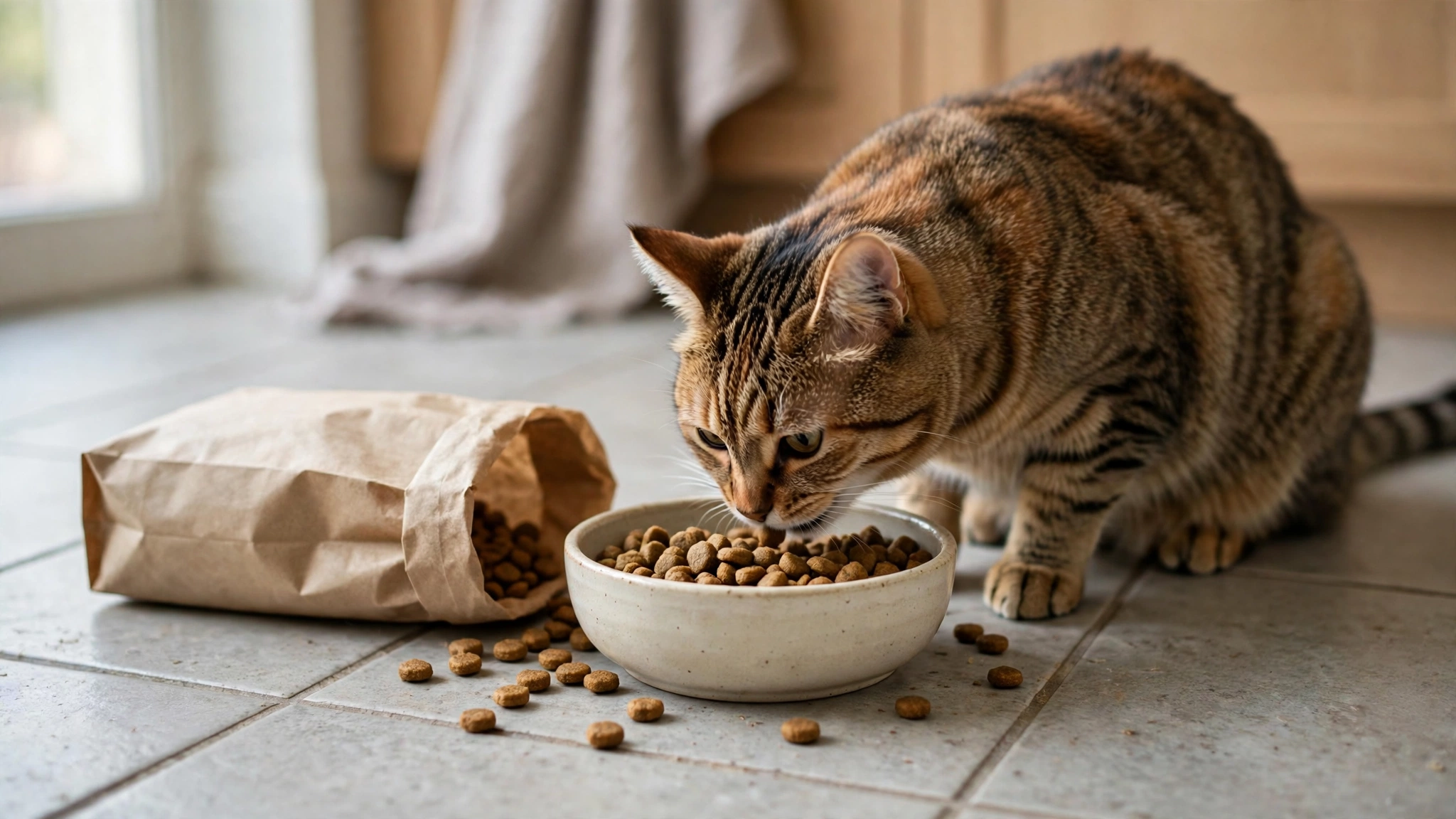
Dry food is not the only option, and many cats eat a mix of dry and wet food. Dry food is convenient, it keeps well, it is easy to measure, and it is usually cheaper per day than wet food. That convenience is one reason the best dry cat food for a busy household is often the one that fits the routine as well as the cat. It also suits grazing, because it can sit in the bowl without spoiling quickly. Wet food has a much higher moisture content, which helps with hydration, and many cats find it more appealing.
It is also worth remembering that cats can eat other foods besides their main diet, but not every human food is safe for them. If you are wondering about a specific food, our guide to whether cats can eat eggs explains what is safe and what to avoid, and the same careful approach applies to any extra you offer. Can cats eat eggs?
Switching Foods Without Upsetting Your Cat
Cats are creatures of habit, and a sudden change of food can cause a stomach upset or a flat refusal to eat. The gentle way to switch is to mix the new food with the old food, starting with a small amount of the new food and increasing it over a week or so. Most cats adjust within that time, though some fussy cats take longer.
Watch your cat during the switch. A healthy appetite, normal energy, and normal litter habits are good signs. If your cat stops eating, seems unwell, or has digestive problems that last more than a day or two, go back to the old food and talk to your vet. A cat that refuses to eat for more than a day is a reason to seek veterinary advice promptly, because cats can become unwell quickly when they stop eating.
When to Talk to Your Vet
A vet is the best source of advice about your individual cat, and there are several moments when a conversation is worth having. If your cat is a kitten, a senior, or has a health condition, ask which type of food fits them — that conversation is the fastest route to the best dry cat food for your individual cat. If your cat is gaining or losing weight, ask how much to feed and whether a different formula would help. If your cat has a sensitive stomach, a food allergy, or a poor coat, ask whether the food could be part of the picture.
Frequently Asked Questions About the Best Dry Cat Food
What is the best dry cat food for kittens?
What is the best dry cat food for kittens? The best choice for a kitten is a food made for kittens — or for all life stages — that carries a statement saying it is complete and balanced for growth. Kittens need a food designed for their rapid growth, and they are usually fed a kitten formula until around their first year. Your vet can advise on the right time to switch to an adult food.
How do I know if the best dry cat food I picked suits my cat?
How do I know if the best dry cat food I picked suits my cat? Look at your cat over a few weeks: a healthy appetite, a good coat, normal energy, and normal litter habits are reassuring signs. Steady weight is the most useful measure — a cat that is steadily gaining or losing weight may need a different amount or a different food. If you are unsure, ask your vet to check your cat’s body condition.
Is expensive dry cat food always better?
No. Price reflects ingredients, marketing, packaging, and distribution, and a higher price does not guarantee a better fit for your cat. A mid-priced food that matches your cat’s life stage and that your cat eats happily is a better choice than an expensive food that goes uneaten.
Is grain-free dry cat food better for cats?
Not automatically. Grain-free foods replace grains with other starches, and whether that matters depends on the food as a whole and on your individual cat. Some cats do well on grain-free food, others do well on food with grains. Unless your cat has a known sensitivity to a specific ingredient, the presence or absence of grains is not the most important thing on the label. In the end, the best dry cat food is judged by the whole label and by your cat, not by the presence or absence of one ingredient.
How much dry food should I feed my cat each day?
Start with the feeding guide on the bag, which is based on your cat’s weight, and adjust from there. Active cats may need more and indoor cats may need less. The right amount is the one that keeps your cat at a steady, healthy weight, and your vet can help you set it.
Can I mix dry food with wet food?
Yes, many cats eat a mix of dry and wet food, and that is fine as long as both foods are complete and balanced and the total amount is right. Wet food adds moisture, which helps with hydration, and dry food is convenient and easy to measure. Adjust the amounts so the total stays the same, and ask your vet if you are unsure about the balance.
The best dry cat food is not the bag with the loudest promise or the highest price. It is the one that matches your cat’s life stage, carries a clear complete and balanced statement, lists ingredients you can understand, and — most importantly — is the one your cat eats happily, day after day. Learn to read the label, keep the amount right, and check in with your vet as your cat grows and changes. Do that, and the crowded aisle becomes much easier to navigate.