Whole House Water Softener: How It Works and What to Know Before You Buy
If your taps leave white spots on dishes, your shower leaves your skin feeling dry, or your kettle builds up scale surprisingly quickly, hard water may be the cause. Hard water contains higher levels of dissolved minerals, mainly calcium and magnesium. It is not usually a health concern, but it can be a nuisance around the home, affecting appliances, plumbing, laundry, and cleaning.
A whole house water softener is designed to treat all the water that enters your home, rather than just the water at a single tap. Before you decide whether one is right for you, it helps to understand how these systems work, what they can and cannot do, and what affects their cost and upkeep.
What Is Hard Water?
Water picks up minerals as it moves through soil and rock. In areas where the ground contains a lot of limestone or chalk, the water supply tends to be harder. Hardness is usually measured by the concentration of calcium and magnesium in the water, and levels vary widely from one area to another.
Common signs include limescale buildup on taps, showerheads, and kettles; spots on glasses and dishes after washing; soap that does not lather easily; laundry that feels stiff; and a dry or filmy feeling on skin and hair after washing. Over time, mineral deposits can also build up inside pipes, water heaters, and appliances, which may reduce their efficiency. If your water heater is reaching the end of its life, see our guide to tankless water heater installation.
If you are unsure whether your water is hard, you can check with your local water supplier, which often publishes water hardness information for its area, or use a home test kit. Knowing your water hardness is a useful first step, because it affects the size and type of system that might be suitable. The US Geological Survey explains how water hardness is measured.
How a Whole House Water Softener Works
Most whole house water softeners use a process called ion exchange. Inside the system is a tank filled with small resin beads. As hard water flows through the tank, the beads attract and hold the calcium and magnesium ions, and release sodium ions in exchange. The water that leaves the tank is therefore softer, with much of the hardness-causing minerals removed.
Over time, the resin beads become saturated and need to be refreshed. This is done through a process called regeneration. During regeneration, the system flushes the resin with a salty solution, which washes away the collected minerals and restores the beads. The used solution is then drained away. Regeneration can be set to happen on a timer, after a certain volume of water has been used, or when sensors detect that the resin needs refreshing. Systems that regenerate based on actual water use tend to be more efficient, because they only regenerate when needed.
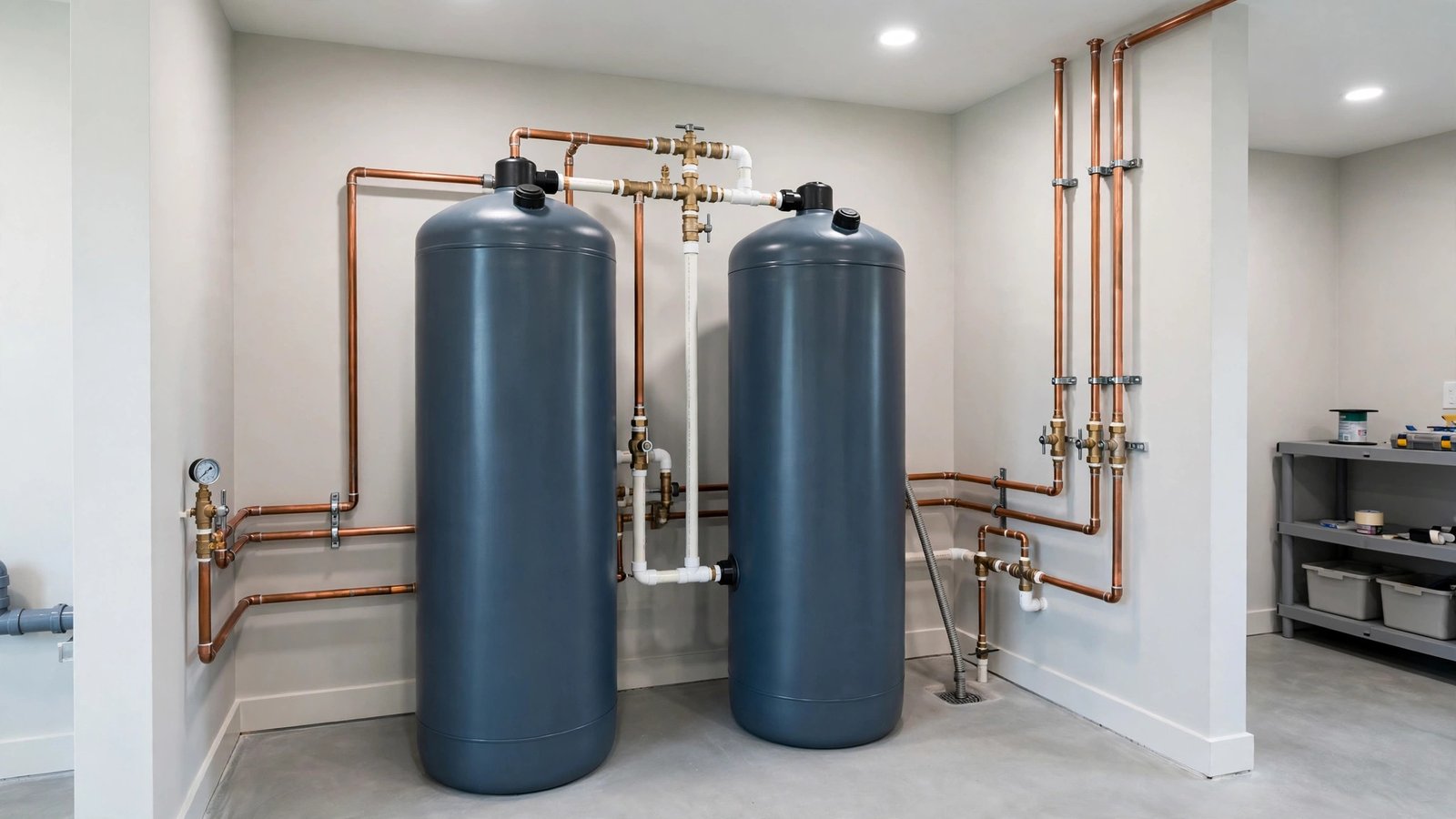
A typical whole house system has a mineral tank that holds the resin, a brine tank that holds the salt solution, and a control valve that manages the flow of water and the regeneration cycle. Some systems also include a pre-filter to remove sediment before the water reaches the softener.
Types of Whole House Water Softeners
The most common type is a salt-based ion exchange softener. These are widely used and are effective at removing hardness minerals. They do need a regular supply of salt, and they use water during the regeneration cycle.
Salt-free systems, sometimes called water conditioners, work differently. Rather than removing calcium and magnesium, they are designed to change the form of the minerals so they are less likely to form hard scale. They do not actually soften the water in the same way, and they do not remove the minerals. They may be an option for people who want to reduce scale without adding salt, but their results and limitations are different from a true softener.
Benefits and Limitations
The main benefit of a whole house water softener is that every tap supplies softened water. That means less limescale on taps, shower screens, and appliances, which can make cleaning easier. Soft water can also help soap and detergent work more effectively. You may find you need less soap for washing dishes, laundry, and bathing, and that laundry feels softer. For appliances such as water heaters, dishwashers, and washing machines, reducing scale buildup may help them run more efficiently and may reduce the need for descaling.
It is worth noting that a water softener does not purify water. It removes hardness minerals, but it does not necessarily remove other contaminants, bacteria, or chemicals. If you have concerns about drinking water quality, you may need a separate filtration or purification system, based on a water test for your home.
What Affects Cost
The cost of a whole house water softener varies widely, and it is not possible to give a single figure that applies to every home. Several factors affect both the upfront cost and the ongoing running costs, and no specific prices are given here for that reason.
The size of the system is a major factor. A larger home with more bathrooms and higher water use generally needs a larger system with more resin capacity than a small home. The hardness level of your water also matters: very hard water may require a larger system or more frequent regeneration.
The type of system affects cost too. A basic single-tank salt-based system is generally simpler than a dual-tank or combined softening and filtration system, which may cost more to buy and install. Features such as water-use-based regeneration, digital controls, and built-in monitoring can also affect the price.
Frequently Asked Questions
How does a whole house water softener work?
Most systems use ion exchange. Hard water flows through resin beads that capture calcium and magnesium and release sodium in exchange. The resin is then refreshed during a regeneration cycle using a salt solution.
Does a water softener remove all minerals from water?
No. A salt-based softener removes hardness minerals, mainly calcium and magnesium, but it does not remove all minerals or necessarily remove other contaminants. Separate filtration may be needed for other water quality concerns.
Do I need to add salt to a water softener?
Salt-based systems need a regular supply of salt for the regeneration cycle. How often you need to top it up depends on your water hardness and how much water your household uses.
Will softened water help with limescale?
Softened water contains much less calcium and magnesium, so it is less likely to leave limescale deposits on taps, showerheads, and appliances. It does not remove existing scale, though that may reduce over time with regular use of soft water.
Conclusion
A whole house water softener treats all the water entering your home by removing the minerals that cause hardness, most commonly through ion exchange. It can reduce limescale, help cleaning products work better, and make water feel softer on skin and laundry, but it does not purify water and it needs regular salt top-ups and maintenance. The right system depends on your water hardness, household size, and plumbing, and the total cost depends on those factors as well as the type of system and installation. Test your water, get professional advice, and compare options carefully before you decide.